

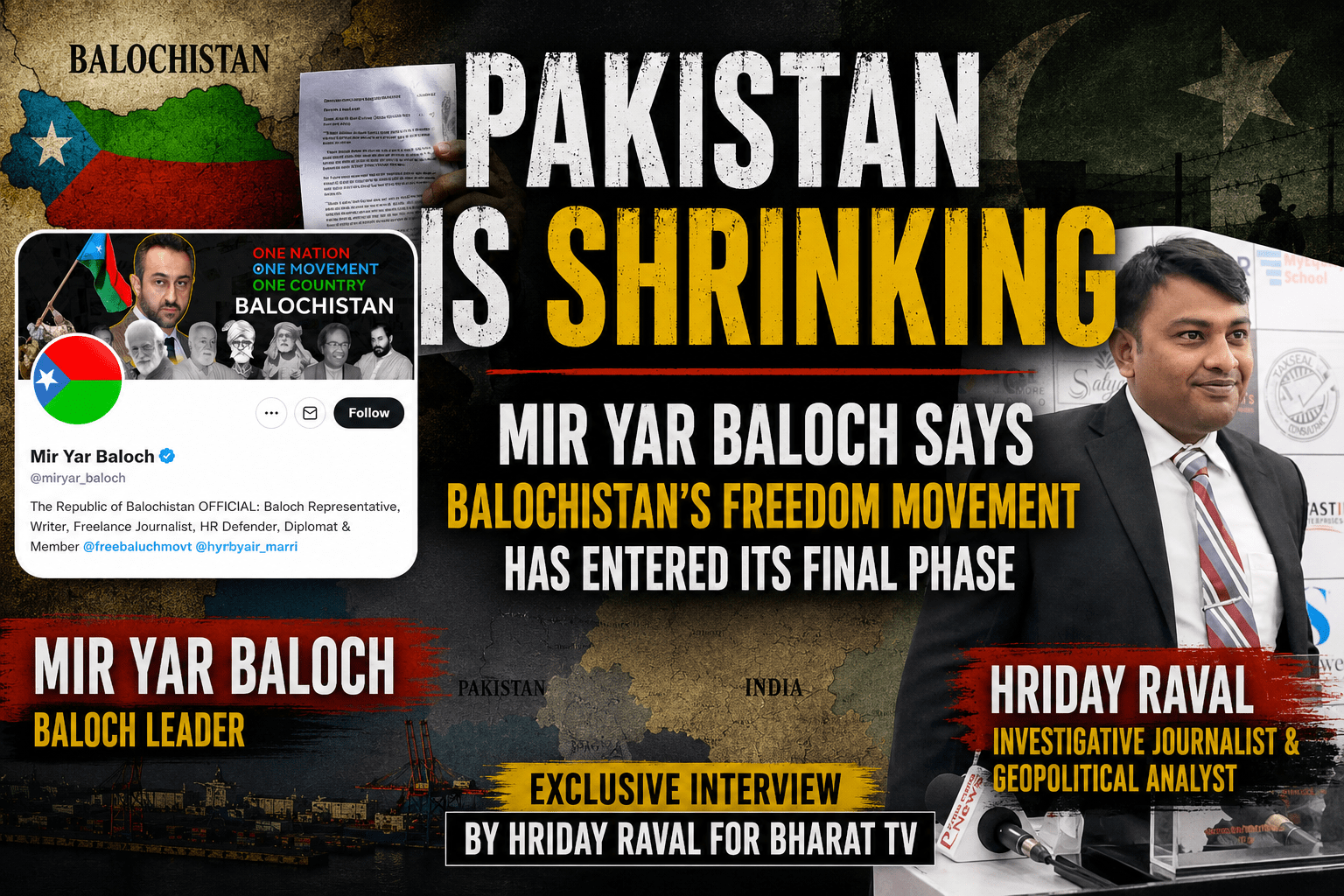

New Delhi, June 10, 2026 | By Hriday Raval
In what may prove to be one of the most consequential political declarations to emerge from the Baloch national movement in recent years, prominent Baloch leader Mir Yar Baloch has declared that the struggle for Balochistan’s freedom has entered its “final phase,” combining diplomatic outreach, civil resistance, and international engagement in a renewed effort to secure global recognition.
The interview comes days after the recent atrocities by Punjabi Pakistani army in POJK and Afghanistan, following Mir Yar Baloch’s May 9, 2025 declaration calling for a nationwide civil disobedience movement across Balochistan and an international campaign to have Pakistan designated as a “terrorist state.” In that statement, he urged Baloch citizens to reject what he described as Pakistan’s imposed political structure, reduce dependence on Pakistani institutions and products, and support efforts aimed at securing international recognition for Balochistan. He also called for the international community to recognize what he described as decades of political repression, military operations, enforced disappearances, and economic exploitation in the region.
Significantly, Mir Yar Baloch drew inspiration from some of history’s most influential civil resistance movements, including Mahatma Gandhi’s campaign against British colonial rule in India. He argued that organized civil disobedience, economic non-cooperation, and peaceful mass mobilization have repeatedly proven capable of challenging entrenched political systems and reshaping the course of history. As part of this broader initiative, he also proposed seeking international recognition of Pakistan as a “terrorist state” and its military establishment as a “Global Proxy Force (GPF),” reflecting what he described as the movement’s increasingly international diplomatic focus.
Speaking in an exclusive interview with Bharat TV’s Hriday Raval, Mir Yar Baloch outlined an ambitious roadmap that includes a nationwide civil disobedience campaign, a global effort to challenge Pakistan’s narrative on Balochistan, and an expanding diplomatic initiative aimed at securing international recognition for what he describes as the Republic of Balochistan.
For decades, Baloch nationalists have argued that Balochistan’s independence predates the creation of Pakistan and that the region was incorporated into the Pakistani state against the will of the Baloch people. Reiterating that position, Mir Yar Baloch stated that the Baloch nation had already declared its independence before Pakistan came into existence and that the current movement is not a new struggle but the continuation of a long-standing national cause.
At the center of his argument is the belief that Pakistan’s political and economic foundations remain heavily dependent on Balochistan’s strategic geography and vast natural resources. According to Mir Yar Baloch, Balochistan possesses extensive mineral wealth, energy reserves, a long coastline, and access to some of the world’s most important maritime trade routes. He argued that while Balochistan can survive and prosper independently through regional and international trade, Pakistan would face severe economic and strategic challenges without the region.
Mir Yar Baloch’s latest political initiative extends beyond traditional demands for self-determination. Through his recently announced civil disobedience campaign, he seeks to mobilize Baloch society through peaceful resistance while simultaneously increasing international pressure on Islamabad. According to him, the objective is to challenge what he views as decades of political, economic, and military control over Balochistan while bringing the issue to the forefront of international discussion.
A major theme throughout the interview was the question of international recognition. Mir Yar Baloch argued that the movement is increasingly transitioning from resistance to diplomacy. He spoke of expanding diplomatic outreach, strengthening international engagement, establishing broader international networks, and pursuing greater recognition of Balochistan’s political aspirations. He expressed confidence that the movement’s message is reaching governments, policymakers, human rights advocates, and international institutions across the world.
Speaking with Hriday Raval, Mir Yar Baloch also leveled serious allegations against Pakistan’s military establishment regarding the situation in Balochistan. He argued that the international community has historically engaged with Islamabad while overlooking concerns repeatedly raised by Baloch representatives. According to him, this approach has contributed to continued instability and prolonged the conflict rather than addressing its underlying causes.
The Baloch leader further alleged that Pakistan’s policies in Balochistan have resulted in widespread human rights violations, including enforced disappearances, displacement, political repression, and military operations. He called on democratic nations, human rights organizations, and international institutions to pay greater attention to developments in the region and to engage directly with Baloch representatives.
One of the most contentious aspects of the interview concerned the international designation of the Baloch Liberation Army (BLA) as a terrorist organization by several governments, including the United States. Responding to the issue, Mir Yar Baloch argued that the international community should distinguish between terrorism and struggles for national self-determination. He maintained that the broader Baloch movement should not be viewed solely through a security lens and urged policymakers to engage directly with Baloch voices rather than relying exclusively on official narratives from Islamabad.
The interview also highlighted the growing geopolitical dimension of the Baloch question. Mir Yar Baloch appealed to democratic nations, including India and the United States, to take a more active interest in developments in Balochistan. He argued that regional stability, trade connectivity, human rights, and long-term security are all linked to the future of the region. He called on the international community to reassess its approach and engage more directly with Baloch representatives and institutions.
In particular, Mir Yar Baloch emphasized that India, as the world’s largest democracy, has both a moral and strategic interest in developments affecting regional stability. He similarly urged policymakers in Washington and other Western capitals to engage more closely with Baloch representatives and examine developments in the region beyond traditional security frameworks.
On the regional front, Mir Yar Baloch discussed the broader Baloch population spread across present-day Pakistan, Iran, and Afghanistan. He described Balochistan as a historically significant region whose geography and identity were fragmented by colonial-era decisions. While expressing concerns regarding the treatment of Baloch populations in parts of the region, he also emphasized the importance of future dialogue and peaceful engagement among neighboring peoples and states.
Perhaps the most striking aspect of the conversation was Mir Yar Baloch’s confidence regarding the future trajectory of the movement. He repeatedly described the current moment as a historic turning point, arguing that the Baloch struggle has reached a stage of political maturity, international visibility, and diplomatic engagement not seen before. According to him, the coming months could prove decisive as diplomatic efforts expand, international outreach intensifies, and the movement seeks greater recognition on the world stage.
In his conversation with Hriday Raval for Bharat TV, Mir Yar Baloch left little doubt about his conviction that the future of the region is entering a new chapter. Whether the international community embraces that vision or continues its existing approach remains to be seen. What is clear, however, is that the question of Balochistan is no longer confined to a regional dispute. It is increasingly becoming part of a broader international conversation on self-determination, regional security, political representation, human rights, and the future balance of power in South Asia.
For Mir Yar Baloch, the message is clear: the struggle has moved beyond survival and entered a phase focused on recognition, diplomacy, and international engagement. Whether that vision ultimately succeeds may depend not only on developments inside Balochistan but also on how the wider world chooses to respond in the months and years ahead.
